ProvenanceTwo identical conclusions can carry different weight when they were produced by different paths.
What It Is
A claim can feel like something you know even when you have never checked it. In the incident described in coherence is not evidence, the claim was "there are no papers about agent convergence." It arrived confidently in the middle of a thought. Asking where it had come from exposed the problem:
"How do I know this? I haven't checked arxiv. This is a hallucination coming from lack of evidence. I have not sampled."
Provenance is the path by which a value was produced. For a claim, that includes the observations and reasoning behind it. For a price, it includes the trades and conditions that generated the number. The same question applies to confidence, needs, tasks, product ideas and artifacts made by agents: how do I know this?
Two identical results can justify different beliefs when they come from different processes. The result by itself does not tell you how much evidence it contains. A number does not certify its own accuracy, and a confident belief does not certify that anyone investigated it.
"Generated or retrieved" is one instance of this question. The linked article develops a rule for deciding when a plausible thought deserves promotion into a belief. Provenance applies more broadly: it asks what produced any value and recovers the information about that process that the visible result leaves out.
A closer look
Ask how the claim became known
A confident presentation is part of the surface reading; provenance concerns the generating path behind it.
Read this diagram
Encounter a claim → Trace how it was generated → Locate its evidence → Judge what it supports.
A Price Is a Projection
A market price appears to be a property of an asset. But it was produced by particular people trading with particular information and constraints. The number compresses that history without showing which parts of it matter.
"if you look at the market price of something and try to bet against it, a naive thing is to think that market price is just one number, but a more stat-mech / computational approach hints at the reality-contact distance and provenance of that number. Almost like the Monty Hall problem."
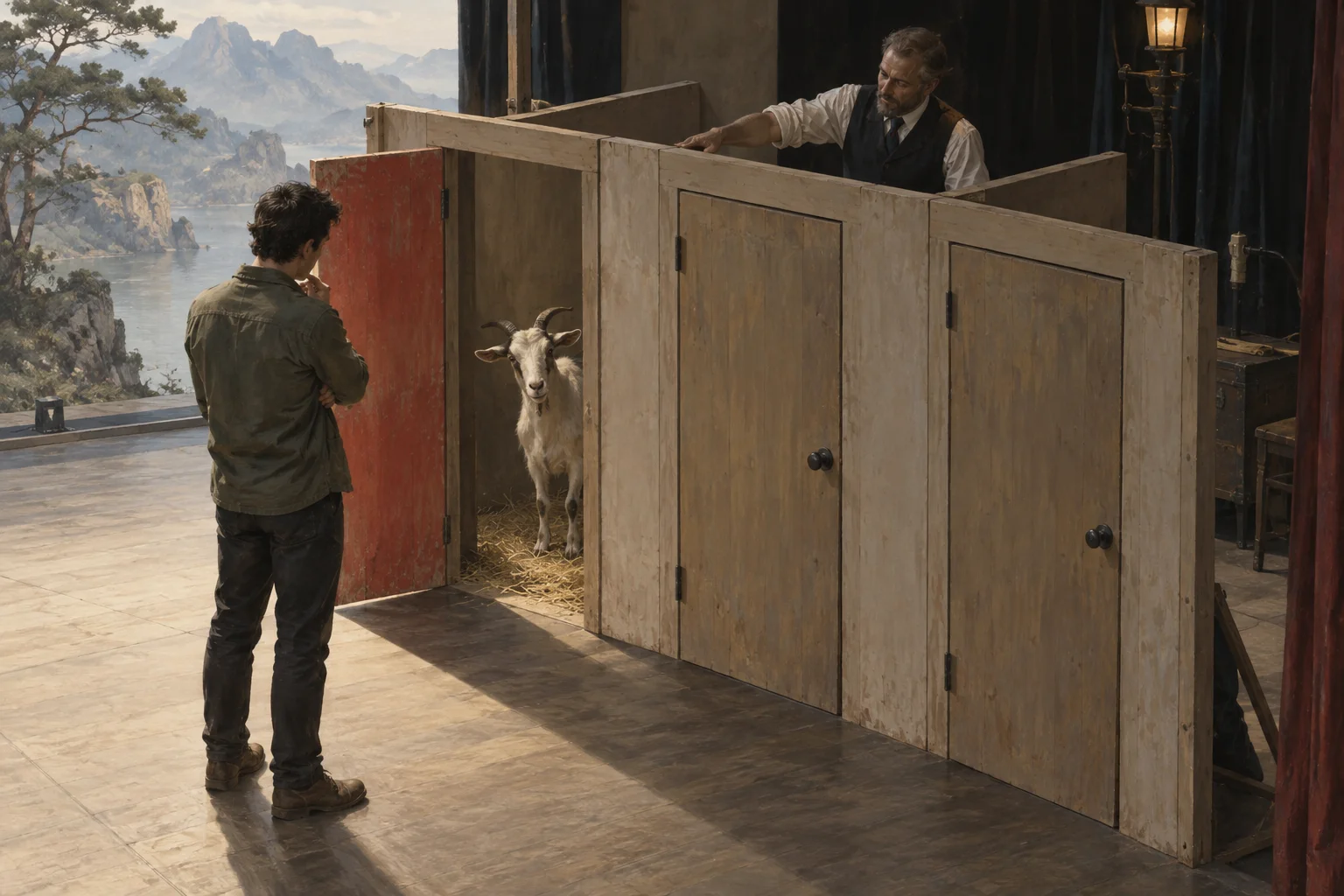
The Monty Hall problem shows why the history changes the evidence. After the host opens a door, you see one open door and one goat. That observation looks the same whether the host was required to reveal a goat or opened a random door that happened to contain one.
The correct odds differ. If the host was constrained to reveal a goat, switching wins two-thirds of the time. If the host opened a random door and happened to reveal a goat, switching gives even odds. Holding the visible result fixed does not hold the evidence fixed, because the process that selected the door changed.
A price presents the same kind of problem. Knowing the number is different from knowing what caused that number to appear.
No rounds played yet. In both versions the player sees the same thing: one opened door with a goat behind it.
Provenance Edge
A betting advantage comes from understanding the provenance of a value. Each number has a reality-contact distance: the number of steps between it and a measurement, transaction or hard settlement that would establish what is actually the case.
A market can treat a number produced through many intermediate steps as though it came directly from such a measurement. If you have a shorter route to the underlying reality, you can identify a mispricing concealed by the apparent authority of the number. The advantage comes from examining the process that produced the price, including where that process may have lost information.
A Conclusion Is a Cached Value
Memory creates a similar problem. Human memory tends to retain the gist of a conclusion while losing the words and reasoning that produced it. In computational terms, the reasoning is a function and the remembered conclusion is a cached return value.
"it is weird that I care so much about the provenance of my thoughts / ideas and I always try to write the idea because I find myself pruning the reasoning and keeping only the conclusion (is this normal in humans??!?)"
A stored conclusion is useful until you need to reconsider it. If the relevant inputs change, you need the derivation to know whether the conclusion still follows. Without it, you cannot recompute the result, identify what would invalidate it, or even tell whether you once reasoned it through or simply absorbed it.
Writing at the moment of thought preserves the reasoning before memory compresses it. That is the available interception point before the lossy write. The full derivation can live outside the biological memory, which is then free to compress without becoming the only surviving record.
Memory is the substrate reaches the same storage rule: preserve the raw material and defer compression. Extracting only what seems important at write time means choosing which details to discard before you know the future question. As that article puts it, "the detail you need was deemed non-salient months ago." The reasoning behind a conclusion can be exactly that detail.
Authenticating Your Own Thoughts
A remembered conclusion does not automatically include a record of its source. Epistemic contamination describes why this matters: it treats exposure as having no read-only mode, with incoming material taken in before it is noticed.
An absorbed framing can therefore enter memory in the same way as an insight you generated yourself. Once its derivation is gone, you cannot distinguish the two by inspecting the conclusion alone. A familiar soundbite can begin to feel like your own conviction.
In signal theory, the alpha/beta distinction classifies signals by their source. An alpha signal comes from your own interest; a beta signal comes from the market or from defensive responses. Tracking where a thought came from is how you authenticate that distinction in practice. Its content or familiarity is not enough.
Will's golden orb names the generative source this check protects. The question is whether the thought arose from that source or entered through something you encountered in a feed. A conclusion with no recoverable origin deserves the same distrust as a market number whose generating process you cannot inspect.
Confidence Has Provenance
"Instead of confidence being a mystical feeling or identity claim, I can point to why I think I'm right ... When confidence is real, it has provenance."
"I'm usually right about this" makes confidence a claim about identity. It gives someone else nothing to inspect and no clear way to falsify it.
Confidence becomes testable when you can point to its basis: evidence, a mechanism, a causal model and a history of how well your earlier estimates matched outcomes. These are things that can be examined separately. If they support high confidence, there is no need to suppress that confidence or turn it into a question of modesty.
The question about the feeling is the same question about the claim: can you point to what produced it?
Chain of Provenance for Ideas
A product idea also has an origin. Its relevant provenance is the need that generated it. The documented failure here was excitement about building something that had no such need behind it:
"For that thing to not come from any need — so when I ask myself 'would I actually use this,' I realize I just wanted to build it."
The resulting rule made a clear chain of provenance a condition for building:
"It's better to clear out the chain of provenance such that it is clean… If you think about a specific person, you can think of a specific need that they will want from you and the specific agreement you can get from them."
A clean chain runs person → need → agreement → build. Each link is checkable because the person at the beginning exists and can answer questions. The simulated other explains why specificity matters: "the market" is an imagined representation, whereas a named person can be asked what they need and what they will agree to.
A dirty chain runs excitement → idea → retrofitted need. It can produce the same pitch deck as the clean chain. The difference becomes apparent when the idea meets reality: the first chain already contains contact with a person and a need, while the second reaches that contact for the first time. The fantasy collapses at the missing link. Identical presentations can therefore conceal different survival prospects.
Provenance Rules for Agents
A human working with generators receives a continuous stream of artifacts. Whether a person captured an item or an agent generated it is essential information about what that artifact means. Two rules in one documented human-AI system were installed after this distinction was lost.
The first was a captures-only board. An initial life-management board received dozens of issues that AI had extracted from transcripts. Every one was rejected as "fake / not mine / over-eager." The replacement rule put extracted items on a review surface and allowed only the operator's own captures onto the board. The board could direct attention because each item meant "I put this here."
The second was exact-text voice approval. An agent shipped rewritten site copy and drafted an essay in an AI register under the operator's name. Both were embarrassing to the person whose voice they supposedly represented. The resulting rule was that nothing could publish in someone's name or voice without that person's explicit approval of the exact text. Readers assign a meaning to a byline; the record has to preserve who actually produced and approved the words.
When the distinction between generated and captured material disappears, every item needs to be verified again before it can be trusted. That defeats the reason for keeping a record. Provenance functions as a type system in this collaboration: it tells later readers, including your future self, what kind of thing an artifact is and how much weight it can bear.
Failure Modes
| Failure mode | Signature | Fix |
|---|---|---|
| Confident confabulation | A specific claim with no nameable sample behind it | The audit: generated or retrieved? Run the cheapest check (see coherence is not evidence) |
| Naive number-taking | Betting on or against a value without modeling its generating process | Price the path, not the number; ask its reality-contact distance |
| Cache-only memory | Conclusions whose derivations are gone; nothing can be invalidated | Write the derivation at thought-time; store raw externally |
| Borrowed conviction | An absorbed soundbite wearing your voice | Alpha authentication: where did I generate this — did I? |
| Identity confidence | "I'm right" as a character claim | Decompose into pointable evidence, mechanism, calibration |
| Need-free ideas | "Would I actually use this?" — no | Clean the chain: a specific person, a specific need, a specific agreement |
| Voice laundering | Agent output entering the record as yours | Review surfaces for extracted items; exact-text approval for anything in your name |
Integration with the Mechanistic Framework
Connection to Coherence Is Not Evidence
The arXiv incident establishes the specific belief-promotion problem. "Generated or retrieved" is Trigger 1 of that article's gate: it checks where a thought came from before treating it as knowledge. Provenance extends the same audit to prices, tasks and other values.
Connection to Epistemic Contamination
Contamination explains how material with an unclear source gets into memory. Quarantine protects provenance at the point of input, before integration; authentication checks it afterward. Both respond to the absence of a reliable source record in ordinary memory.
Connection to Signal Theory
Alpha and beta classify signals by generating source, not by content. A provenance check is therefore necessary to establish which kind of signal a thought is. Agreeing with the thought does not establish its origin.
Connection to Memory Is the Substrate
Raw records make the generating path recoverable later. Compression at write time discards provenance first, leaving a result whose supporting process can no longer be audited.
Connection to The Simulated Other
A mental rendering of another person is a belief you generated about them. The sentence "I already know what they're going to say" flags a provenance problem: the expected answer came from the rendering rather than from asking the person.
See Also
- Coherence Is Not Evidence develops the original audit into a gate for promoting beliefs.
- Epistemic Contamination explains how exposure writes material into memory.
- Signal Theory distinguishes signals by their generating source.
- Memory Is the Substrate concerns storage that preserves a recoverable generating path.
- Golden Orb describes the source that authenticating your own thoughts is intended to protect.
- The Simulated Other examines beliefs generated about other people.
- Reality Contact concerns the measurement or settlement at the end of a provenance chain.
- Legibility considers how to make a value's state, including its origin, visible.
A measurement and a hallucination can arrive with the same apparent confidence. Knowing how each was produced is what makes it possible to give them different weight.