BasinA long-lived question needs a boundary that collects relevant material and a synthesis that changes as evidence arrives.
What It Is
A pursuit can last for years while the sessions spent on it last for hours. Its observations, decisions, and open questions need to survive between those sessions. Otherwise, returning to the goal begins with reconstructing what was already learned.
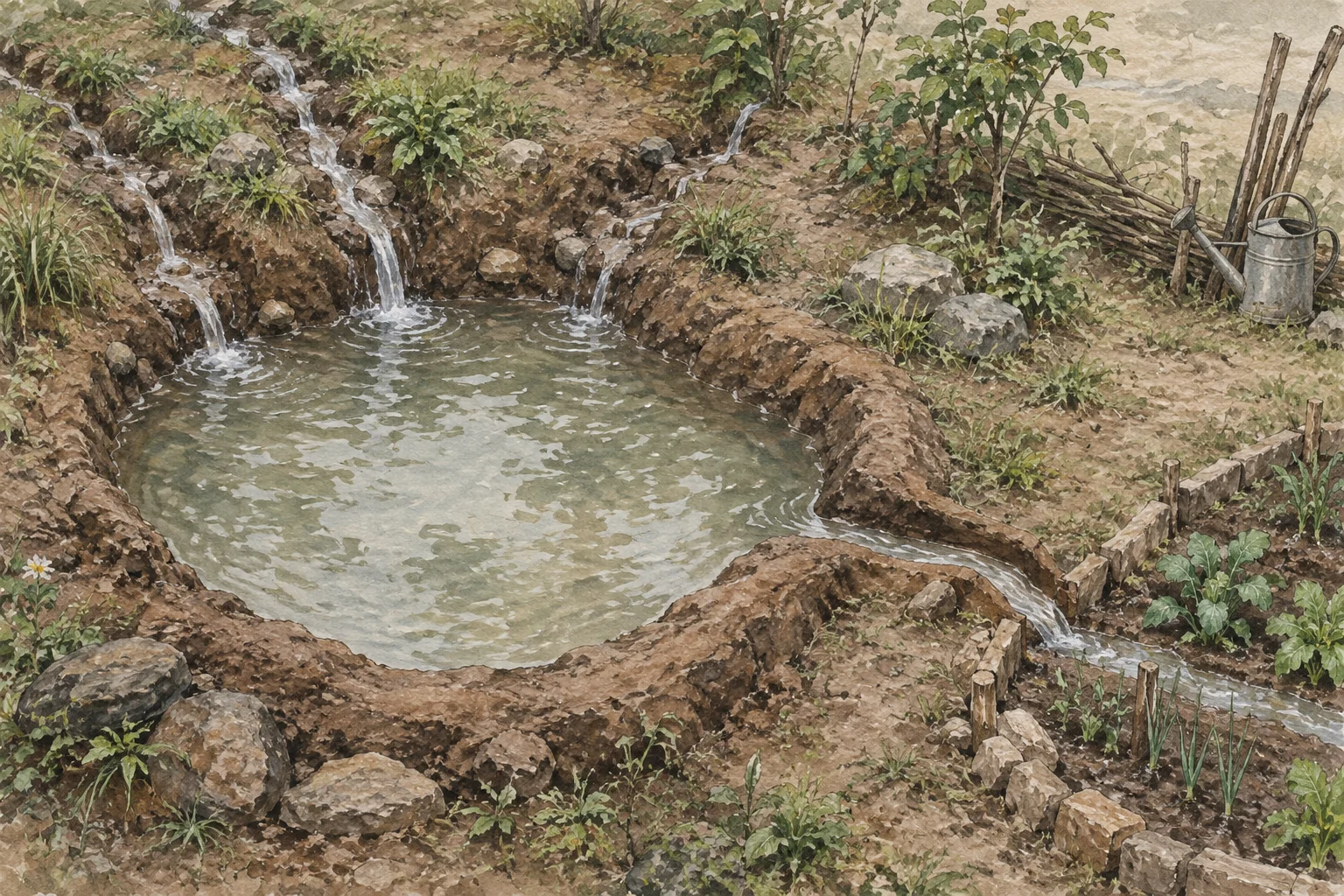
A basin is, in Will's definition, "a metaphor for a structure that accumulates information." It gives one pursuit a persistent question, a retrieval boundary, and a living synthesis. Relevant material can arrive during other activities, retain its provenance, and update what is currently believed about the question.
The accrual substrate stores material across a whole life. A basin scopes that material to a particular goal. The substrate answers where everything lands; the basin answers where everything about this pursuit lands. Its lifetime follows the goal, extending beyond a session, conversation, or agent run.
A closer look
The three parts of a basin
These are the basin's organizing parts, not stages that finish once and stay finished.
Read this diagram
Levels in order: Declared question; Retrieval boundary; Living synthesis.
Three Senses of One Word
The wiki uses “basin” in three related senses:
| Sense | What it is | Where it appears | How you got there |
|---|---|---|---|
| Attractor basin | A low-energy region of a behavior landscape that pulls trajectories in and holds them | Macrostate engineering: a life confined to one routine samples one basin and mistakes that basin's average for the world's. Container design: changing the environment places desired behavior in a low-energy basin. | You fell in |
| Semantic basin | A persistent question + retrieval boundary + living synthesis that collects material for one pursuit | The long-horizon pillars of a research agenda or a venture thesis | You dug it |
| Formal basin | A declared macrostate + acceptance criteria + termination condition + budget, persisted as state in an orchestration system | An agent-orchestration system's ontology | You dug it, formally |
The semantic and formal senses describe the same mechanism at different levels of specification. A semantic basin gathers material around a question. A formal basin makes that question executable through acceptance criteria, a termination condition, and a budget. This article is about the dug kind.
An attractor basin describes behavior and belongs to the energy-landscape vocabulary of statistical mechanics. Falling into one is usually the problem. The shared geometry explains the use of the same word: material flows into the shape and remains there. A semantic basin deliberately creates that destination for observations instead of allowing them to disperse. Water reaches a basin by running downhill; an observation reaches this kind only when someone routes it there.
A Pillar Named Only in Your Head Cannot Collect
Will had named several long-term pillars without creating persistent places for their material. Naming alone had not made the pursuits accumulate:
"A pillar named only in my head cannot collect."
Observations arrived on walks, in logs, and during conversations. Attention routing could identify the relevant pursuit, but the route still needed a destination. Without one, the observation disappeared or entered the general archive. It remained findable in principle without advancing the particular question. The pillar stayed at its initial level of development, and each new session re-derived it.
The same issue appeared during free afternoons. Will described "'free time' was an unindexed search space holding ~6 different kinds of work... the lane taxonomy is the index." Giving each kind of work a basin with a queue turns an open block into a choice among lanes. It avoids searching the entire space at the moment executive function is weakest.
A basin also differs from a visible tracker. A tracker supplies feedback by comparing the declared goal with the current state whenever it is seen. A basin collects what is learned while pursuing that goal. Without the tracker, the pursuit drifts; without the basin, its observations are forgotten. Both are needed.
Anatomy: Question, Boundary, Synthesis
The three parts perform different jobs.
The persistent question defines relevance. It states the macrostate and what would have to become true for the basin to close. It specifies desired properties while leaving implementation open. Without that question, the collection cannot distinguish useful inputs from noise and becomes a folder of loosely related material.
The retrieval boundary defines where to look. It specifies which sources, collections, and parts of the record belong to the search. This is a scope over territory, distinct from a bounded-search budget. A gas limit controls how long a search runs; the boundary controls where it runs.
The living synthesis records what is currently believed. Each claim retains provenance linking it to the observation that produced it. New material must change the synthesis when it changes the evidence. Appending records without updating beliefs produces an archive rather than a living basin.
Agents Are Cattle; Basins Are Not
The formal version appears in an agent-orchestration system that persists the work's state instead of worker identities:
"Agents are cattle; macrostates are not... persist state (basins, ledger, frontier) and you only learn anything by reading a state transition."
A basin is the durable declaration: title, acceptance criteria, termination condition, and budget. Workers are anonymous, disposable subprocesses. Their conversation is not the record from which progress must be reconstructed; state transitions are.
Identity resides in the ledger: "identity in the ledger, minds are water, the human is the lock." The system enforces the definition when state is written. A basin without a termination condition cannot be constructed, making that condition a type constraint rather than a convention.
Session Duration Equals Goal Lifetime
A real goal often needs more context and work than one session can contain:
"Right now you can't prompt your way into Berkeley… there's so much other context that lives beyond one session. You maybe need a hundred or two hundred sessions to get all the pieces together… How do you manage that?"
Will's answer identifies all three parts of a basin: "It's a search process… you need to save information about what happened, update your model about what works and then where to look." Saving what happened builds the collection. Updating the model maintains the synthesis. Choosing where to look sets the retrieval boundary. The state of this multi-year search must persist between episodes.
Long-lived session tabs had already begun doing that informally. Each had become a persistent agent for one pursuit, and its accumulated context was the asset. The general rule was "a goal / task / to-do item / MACROSTATE should be its own agent — partition by GOAL, not persona". The goal determines the unit of agency and its duration. A branch is a goal-agent that remains alive until it is merged.
Basins vs Containers
Containers bound time and behavior. A gym block changes what a person does while inside that block. The container is locally engineered: a bounded region of space and time makes some actions more likely than others.
A basin holds information and goals whether or not a session is currently active. The body-recomposition goal served by the gym block needs somewhere to retain its evidence because it outlives each workout. The container supports the session; the basin preserves the pursuit across sessions.
A ratchet does another job: it prevents loss of a state already achieved. A basin collects new material about a question, while a ratchet holds gains. Without collection, the pursuit repeatedly reconstructs its understanding. Without retention, it backslides.
The Spill Condition
Collection is intended to lead to action. A basin "spills mature pressure into experiments and artifacts." As observations accumulate and are synthesized, a belief may stabilize by continuing to survive new evidence. It can then produce an experiment, artifact, decision, or draft.
A synthesis that never produces anything has become storage without a use. This is the information-side equivalent of keeping branches without merging them in branching and convergence. The termination condition specifies this exit formally. In the formal version, every basin declares what would end it and refuses construction without that condition.
Failure Modes
| Failure mode | Mechanism | Signature |
|---|---|---|
| Named-in-head pillar | No physical catchment; routing has no destination | Every session on the pursuit starts from scratch |
| Bottomless basin | No termination condition; collection as an end in itself | Years of material, no spill, no closed question |
| Boundaryless basin | Everything is relevant; the walls dissolve | The basin degrades back into the undifferentiated substrate |
| Dead synthesis | Appends accumulate but beliefs never update | An archive wearing a basin's name |
| Persisting the minds | Worker identity kept, state discarded | Reading agent chatter instead of state transitions; nothing learned |
See Also
- Accrual Substrate provides the life-wide collection that a basin scopes to one goal.
- Macrostate Engineering defines the question and supplies the visible tracker that complements collection.
- Container Design bounds behavior during a session, while a basin retains information across sessions.
- Attention Routing needs an existing destination for the information it directs.
- Bounded Search limits duration; retrieval boundaries limit territory.
- Ratchet retains gains while a basin collects new evidence.
- Branching and Convergence treats the spill as a merge. A basin that never produces an output holds unrealized possibilities.