Mode-LockWill describes strong inertia once an activity takes hold, making entry conditions a practical design concern.
What It Is
Will can stay in deep work for 8 hours or walk for 9 hours once the activity has captured him. The same tendency can keep him watching YouTube: "it's just thirty minutes. It's just an hour... sooner or later it's two and a half hours passing."
He calls this mode-lock. Once an activity or identity becomes the active mode, it holds itself in place, for hours within a day and for days across a stretch.
"What I have discovered about myself is I am very sensitive to mode-lock — I need to be in a certain mode... This is not a deficiency, this is actually a superpower. Things can be a superpower if you're able to design systems around them that exploit their natural benefits."
The inertia works in both directions. It sustains activities Will values and activities he meant to stop. The mechanism does not distinguish between those outcomes, so the useful intervention is to change what captures him in the first place. Fighting the inertia after an unwanted activity has taken hold is a different problem from arranging for the wanted activity to capture it.
A closer look
The mode reinforces itself
This is a picture of the reported pattern. The article separately discusses useful locks, harmful locks and transitions out.
Read this diagram
Enter an activity → Its cues stay present → Continue in the mode → The mode grows familiar → Enter an activity.
The Lock Installs in Minutes
Will notices that a short period of contact can be enough to adopt an identity:
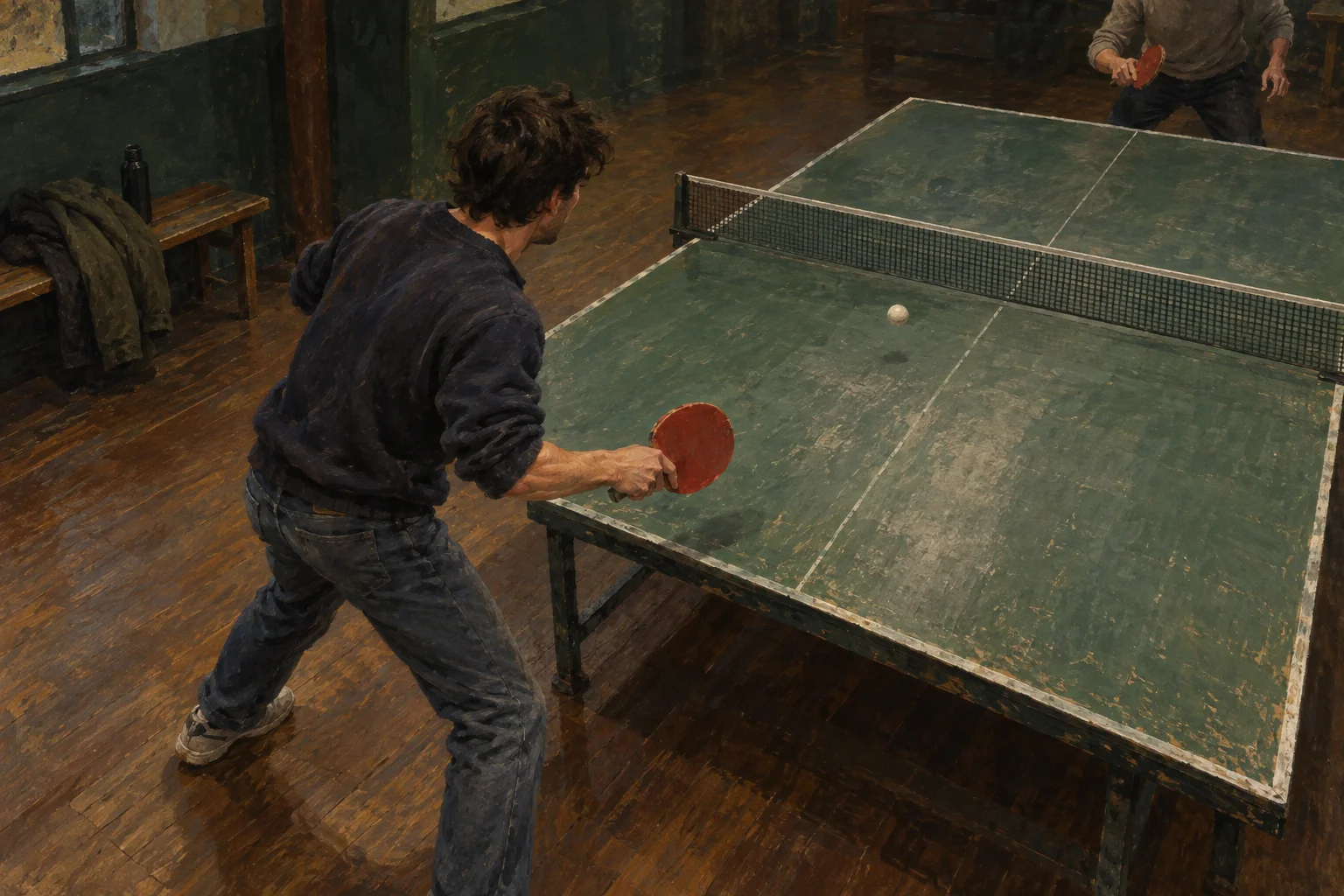
"As soon as I just enter the gym for like five minutes, I flip my mind to: oh, I'm a gym person. That's my superpower — I adopt the new identity very fast. Like, oh, I play ping pong once, now I'm a ping pong star. A lot of people need many, many months, but immediately, once I find something, I attach my identity to it... It works in a positive way but also works badly too."
Five minutes in the gym changes how he answers "what does someone like me do next?" The identity then guides the rest of the session. For him this speed also applies to unwanted patterns: a few repetitions of a bad loop install the corresponding identity just as quickly.
Ignition explains the entry process: installation through a few repetitions, daily loading through a warm-up, maintenance through something like a paid membership, and reinstallation after decay. Mode-lock describes what happens once the state is active: it persists, influences small decisions and affects other behaviors.
Votes and Costly Signals
A mode influences more than the activity that began it. When "I'm on a diet" is active, each food choice is evaluated through that identity. Choices consistent with the identity reinforce it, so the mode helps maintain itself.
"The gym is not just exercise. It is a daily reminder of who I am trying to become."
A gym visit can therefore matter even when it contains little exercise. A three-minute visit still reinforces the identity. Reliable contact is what makes the gym a keystone for other choices; the session does not need to be heroic to perform that role.
A costly action supplies stronger evidence than a cheap statement:
"It would be a costly signal if I was late because of the gym, which would reinforce my identity... being late because I went to the gym is going to be a powerful signal to my mind."
For Will, being late because of the gym is worth the cost because it reinforces the identity. His mind gives that evidence more weight: an affirmation is cheap, while accepting a consequence demonstrates that the activity mattered enough to pay for it. The cost is what makes the signal powerful.
The wording of the entry task also changes what it asks you to do: "the quest should not be 'go to gym' but 'be at gym.'" Going frames a task that can be completed and checked off. Being there frames a continuing state, with the workout emerging from that state afterward. Spell-Packet explains how the phrasing changes the act; here the consequence is that presence loads a mode rather than merely completing a to-do item.
The Negative Lock
Removing a recurring activity can also remove the support it gave to other behaviors:
"I think a huge part of why I'm not eating healthily is the mode lock. If you take away the gym (because free time is scarce), then the one thing casting votes about me being on a journey to be in shape is lost."
Cutting the gym seemed reasonable when free time was scarce. But the gym had also been keeping the in-shape identity active. Eating habits and small vices were influenced by that identity, rather than maintained independently. Once its recurring reminder disappeared, those behaviors changed too.
A change of place can load a different mode without an explicit decision:
"It is interesting: the mode-lock effect. When I am in LA I feel like I am on vacation, so I do not mind eating donuts... But now that I am back — now calories matter again. Now timing matters again."
Will's knowledge about food had not changed. Being in LA had activated vacation mode; returning home made calories and timing relevant again. The positive change can spread across domains just as quickly. One day of simple, functional eating at home can be enough to establish a saving mode. Eating for function and gym attendance reinforce each other, while small purchases become noticeable again.
The Three-Day Rebuild
The short initial contact and the month of practice described in 30x30 operate at different timescales. Rebuilding a productive mode after it has collapsed has an intermediate timescale in Will's experience:
"We put in a couple of hours yesterday... and now it's easier to start. Just one day — normally it takes around three days to build up. So this is day two of three."
One day of doing the work changes how likely starting feels the next day. For Will, rebuilding normally takes roughly three consecutive days of sitting down before starting becomes easy again. Knowing that pattern changes how a difficult second day is interpreted. "Day two of three" describes where the process is, so early difficulty does not become a verdict on the person or the work.
Will also distinguishes reluctance before entry from preference once the mode is active: "I always thought that I don't want to work on something, but then it just means that I haven't started. Same thing with my diet." The felt aversion is mostly a consequence of not yet being in the mode. In his experience it usually reverses once loading begins.
Ignition examines the doubt, dread and misleading feelings that appear before starting. Mode-lock explains why a report of "don't want to" from outside the activity is unreliable: the conditions producing that feeling change when the activity begins.
Modes, Not Quotas
A mode supplies a setting with an entry threshold, a reason for being there, fewer branches to choose between, and something to keep engaging with. That sustains behavior over weeks. A quota instead makes the passage of time the task:
"If I just forget about the length of time and focus on 'okay today I'm trying to explore this area of SF on foot'... then yeah it's aligned."
Exploring a particular area of SF gives a walk something to follow. For Will, framing a 9-hour walk as exercise produces exhaustion and rebound; framing it as exploring somewhere because you want to know what it feels like lets it sustain itself.
Will describes the difference this way: "If I see it as functional, I do not stay with it; if I see it as existential — like it is a mode of being — I naturally stay in that mode." The activity needs to become a way of being there, with its own continuing interest. Adding a required duration turns it back into a quota.
Employment supplies many of these conditions in advance: pressure to wake, a place to go, other people and a recurring cadence. An employee does not need superior self-command to benefit from them. The freelancer who struggles without those conditions is missing a container that the employee already has.
Engineering the Lock
The triggers can be observed and deliberately arranged:
"You can engineer that — you can engineer what makes you get stuck in a certain stage... if you understand what programs you."
The design process has six parts.
- Identify what has established a mode before. For Will, examples include five minutes of physical presence, a paid membership and a visible costly signal. These are ways to install or maintain an identity.
- Choose the setting before an activity captures you. YouTube and deep work can both hold the lock. Container design determines which mode starts on entry and makes leaving costly enough that a competing activity cannot immediately displace it.
- Make entry the initial task. "Be at gym" and a minimum viable session require contact with the activity. Count entries as repetitions; the first session does not have to last a long time.
- Arrange costly evidence deliberately. A visible inconvenience accepted because the identity matters is a strong signal for reinforcing it.
- Protect the activities that support other behaviors. Before removing a recurring activity, identify what else depends on the mode it maintains. Install a replacement reminder before removing that support.
- Plan for the different timescales. For Will, installation takes minutes and rebuilding takes about three days; caching is the work of a month of daily repetition. After a collapse, plan a three-day return and judge the first day as the beginning of that process.
These changes affect the transitions into and out of a mode. In state-machine terms, increasing the cost of leaving makes the desired state nearly absorbing. This resembles hysteresis: the system tends to remain in the state it has entered.
In attention-routing terms, attention is assigned at entry and stays assigned, instead of being redirected every minute. The activation cost of transitions within the mode falls very low. That explains why actions inside it feel frictionless while actions outside it feel impossible. In buffs and debuffs terms, the mode is a standing context that changes how likely each action is until it ends.
Failure Modes
| Failure mode | Mechanism | Fix |
|---|---|---|
| Wrong-attractor lock | The lock is valence-blind; the runtime auto-loads YouTube and holds it for hours | Choose the container before the lock fires; the leverage is at entry |
| Keystone removal | Cutting one anchor (gym, for time-scarcity) silently unloads the mode and collapses its stack | Audit what votes an anchor casts before removing it; replace, never just delete |
| Quota framing | Time-as-task forecloses the mode; functional framing produces exhaustion and rebound | Modes, not quotas; existential framing, not duration framing |
| Reading day-one resistance as preference | "Don't want to work on it" is a report from an unloaded mode | Translate to "haven't started"; buy entry and re-measure from inside |
| Moralizing the rebuild | Day-two difficulty scored as a character verdict | "Day two of three" is a state description; the pattern is known |
| Silent environmental swaps | A new environment loads a new mode without any decision (the LA vacation-mode) | Treat location changes as mode changes; re-declare the mode on arrival |
Integration with the Mechanistic Framework
Connection to Container Design
A container initiates and holds the mode. Crossing its boundary loads the state; the cost of leaving keeps another activity from displacing it. Choosing the container therefore determines what the mode-lock mechanism will sustain.
Connection to Ignition
Ignition treats identity as something that can be installed, loaded, maintained and reinstalled after decay, like a system prompt. It explains the entry cost and why pre-start feelings can mislead. Mode-lock describes how paying that cost once supports hours in the activity.
Connection to State Machines
A locked mode is a nearly absorbing state with costly exit transitions. The same structure can keep someone in a desired or undesired mode. The behavior's value does not change the mechanism that holds it.
Connection to Attention Routing
The lock makes an initial allocation of attention durable. Once the mode is active, the allocation does not need to be decided again at every moment.
Connection to Spell-Packet
The phrases "be at gym" and "I am the kind of person who does this," along with costly signals, install a mode. Spell-Packet describes how those phrases and signals act; mode-lock describes the state that remains afterward.
Connection to Activation Energy and 30x30 Pattern
A loaded identity reduces the cost of transitions within minutes. For Will, momentum builds across sessions over roughly three days. Full habit caching is the work of a month of daily repetition. These describe the same mechanism at three depths, from entry through sustained practice.
See Also
- Container Design explains how a setting initiates the mode.
- Ignition explains identity loading and the difficulty of entry.
- Attention Routing explains the durable allocation of attention.
- State Machines develops absorbing states and hysteresis.
- Buffs & Debuffs describes the mode as a context that changes action probabilities.
- Activation Energy explains why actions within the mode are cheap to start.
- 30x30 Pattern describes a month of daily repetition, beyond the three-day rebuilding period.
- Spell-Packet examines phrases and signals that install a mode.
- Discipline describes how an engineered mode appears from outside.