Be the SunIdeas can disappear after the moment that produced them; collectors and routing give those sparks somewhere to go.
What It Is
An idea can arrive during a walk, a sentence during a conversation, or an insight in the shower. The thought happens without a scheduled production session, but it often disappears before anything can be made from it. “Be the sun” is Will's name for starting with that existing output and asking what would capture and use it.
The ladder of agency describes increasing causal power through demonstrated capability. The sun changes where the work goes: a person already emits ideas and energy, so the next improvement is a set of systems that collect those emissions and turn them into artifacts.
The architecture has a source, collectors, routing, and storage. The person in a golden orb state generates the signal. Recording, transcription, and AI agents capture it. Pipelines send it where it can be used, and the accrual substrate keeps it. The aim is for output to depend on how much of that signal is captured rather than on discipline.
The ladder introduces the sun as a stance, while the golden orb describes the generative state. This account develops the machinery around that state: the systems that turn what is emitted into an effect in the world.
A closer look
From a spark to something usable
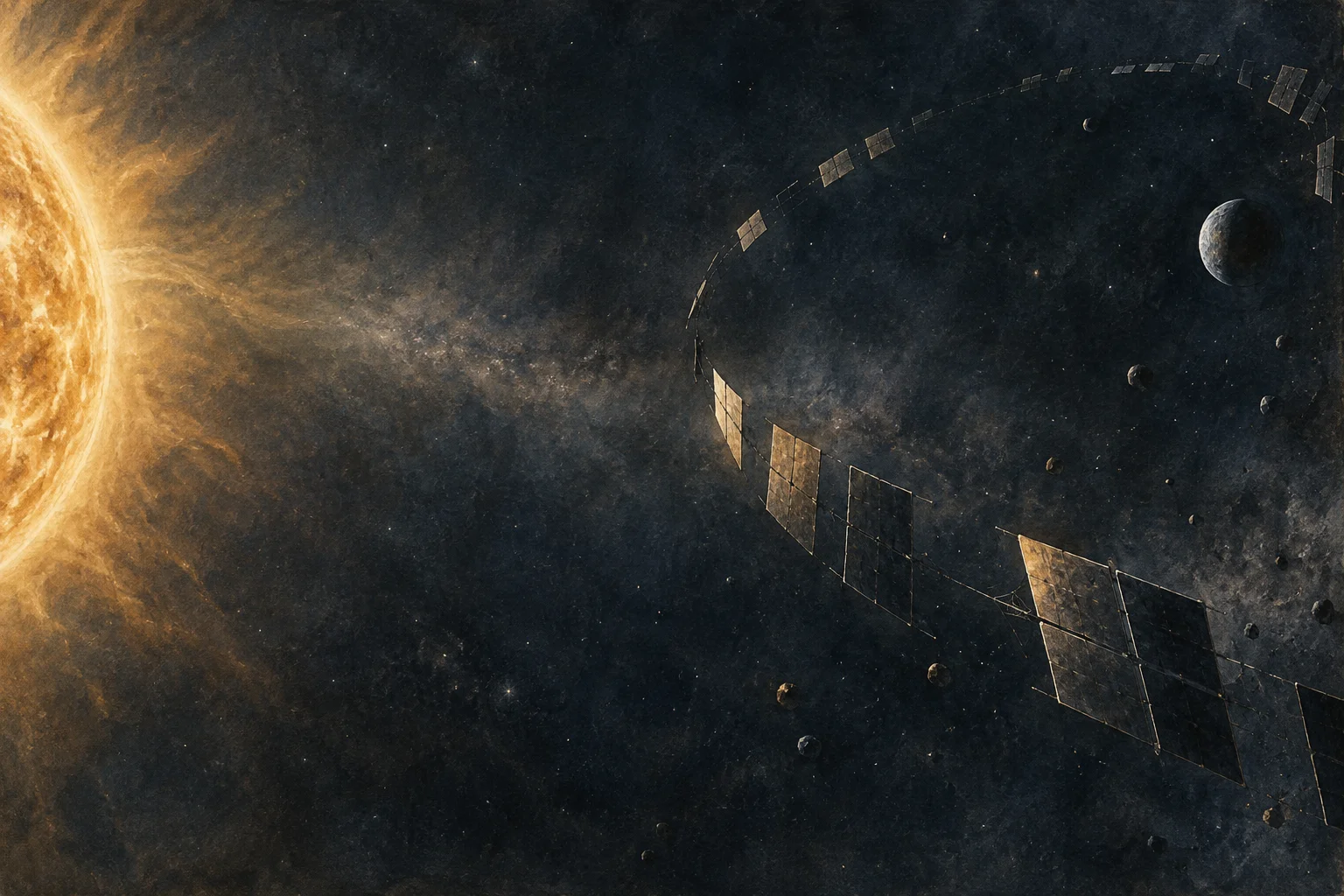
The source-and-collector image shifts attention from forcing more ideas to retaining and developing the ones already emitted.
Read this diagram
An idea arises → Capture it → Route it → Develop an artifact → Keep the result.
The Inversion
During a hike, Will described an alternative to climbing each rung of the ladder:
"Instead of climbing the ladder of agency, you can try to just mimic the sun. Try to be this generative force and then have all these systems capture and use that energy, and use that golden orb... I wanted to be a sun in it. I felt like a leaf because I didn't have the causal energy into the world."
A leaf is moved by wind, trends, and other people's agendas. The sun is upstream of the movement: its heat moves the ocean, the ocean moves the wind, and the wind moves the leaves.
"You want to be the sun that generates out and whose heat moves the ocean, who moves the wind, who moves leaves. Do I want to be that center of causality? I think that's the goal towards agency."
The question changes from how to build the capability for the next scale of action to how to collect the causal energy already being produced. The ladder still exists, but the work moves from improving the person to improving the structures around them:
"It's more like you are upstream of everything, you're the generative source, and from that there's a waterfall... you are building systems that channel your generative energy outwards. You are like water. Intelligence should flow. You're creating the structures that flow and capture your energy."
Intelligence is water makes the related distinction between a source and the structures that direct its flow. The upstream router supplies the choice of where each captured idea goes.
| Climbing the ladder | Being the sun | |
|---|---|---|
| Locus of work | Upgrade the agent | Build the array around the agent |
| Agency comes from | Demonstrated capability at each rung | What is emitted and how much of it is caught |
| Failure mode | Stuck at a rung, waiting for permission | Radiating into nothing (no collectors) |
| Output scales with | Personal effort and mastery | Number and quality of orbiting systems |
| Relation to others | Show a result at one scale before asking for trust at the next | Build them the same collecting systems |
Suns and Solar Panels
Will used solar panels to describe the collecting systems during a dinner:
"Humans come up with ideas and inspiration, and they can feel the energy in certain conversations... I think humans will exist just talking into a microphone and then their energy will get picked up by an array of AI systems around us — sort of like humans are like stars or suns, and the AI systems are like these solar panels trying to gather the energy."
The problem is the gap between what a person generates and what their current working environment captures:
"Humans have this generative energy. You have these ideas, you have these feelings, you have these sparks of insight. I think a lot of it is trapped. We're at our desk using Slack."
Ideas already arise on walks, in showers, and in conversation. Without collectors, the output is lost. The design target is therefore more complete coverage of an existing source:
"What I imagine is: we have the sun of generative energy, more and more. We need agents that surround us like a Dyson sphere to channel that into products that make money. Agents should be [absorbing] the source like a solar panel. That's what I'm trying to work towards."
A Dyson sphere supplies the limiting image: collectors surround the star so no photon is wasted. A personal system can approach better coverage incrementally. A recorder catches walks, transcription preserves speech, an agent turns transcripts into drafts, and an indexer makes utterances searchable. Each addition captures more of a fixed amount of output. The star image stops at one point: a star's output stays the same whatever surrounds it, and a person's depends on the state they are in, which is why the build order below includes protecting generation.
"How do you increase the causal power of one person? Just have a swarm of AI agents around them. I've been building tools to test out that reality myself. I've been taking long walks with an AI listening to me... Can I just live a life where I'm walking in nature, recording myself, and AI just turns it into value?"
The original image also included the collectors remaining attached to their source: "We are like suns. We are like many stars. In fact, I think that's what a star is... think about how there's agents in orbit, like there's things in orbit." In the architecture, that connection comes from the person's data and taste. These keep the systems oriented toward the individual rather than toward a generic task.
| Layer | Function | Instance |
|---|---|---|
| Source | Emit — talk, walk, think, spark | The human in golden-orb state |
| Collectors | Catch emission at the moment it happens | Always-on recorder, ambient capture, journaling |
| Routing | Move captured signal to where it compounds | Transcription → summarization → indexing pipelines |
| Storage | Make every emission permanent and queryable | The accrual substrate |
| Converters | Turn stored signal into artifacts | Agents drafting essays, briefs, products from the corpus |
The collecting systems need persistence, a digital presence, and the ability to act. Those are requirements of an agent body; a collector is only useful if its supporting body keeps functioning.
Creativity as Receptivity
Will keeps the human as the source because of how a generative moment feels to him:
"I have this new theory that we're not really creative — we're just really like antennas for the real creative signal. We're just channeling."
Will described the experience as receiving a thought rather than deliberately constructing it:
"It's like they arrive in your mind with such authority and force. It feels like creativity is receptivity, tuning."
A sentence can appear already formed, with its value recognized immediately. Whether described as a muse, the subconscious, or superposition collapsing, Will's operational conclusion is that these sparks arrive through humans rather than models:
"Now I'm convinced that I can't replace humans, because you need to find that generative spark, and I feel like humans are receptors for the muse. It doesn't come from us. But we are attuned to it."
Reception needs recording as well as tuning. A received signal that nothing records leaves nothing to build from. For Will, speech is the highest-bandwidth way to collect it: "You do not know what you're going to talk about, because you're not what you say... you're just directly opening your channel to the muse when you open your mouth."
Seeds and Crystals
The initial material is often smaller than an essay or a plan. A sentence can supply the starting point around which a larger piece is constructed:
"How people actually work is they don't go from the top down necessarily. They are antennas for some spirit-world muse. Sometimes the perfect phrase and sentence just pops in your mind, and it's so compelling and arrives with so much authority that you don't even care — you just build the argument around it... Writers are just people who collect them and then crystallize and grow crystals around them."
The need for context creates the next layers of work:
"The right sentence just kind of pops out. And then — oh shit, the sentence can't exist by itself. So you need to write the paragraph around it, and then the essay around it, and then the book around it. But it starts from these sparks. So what I'm trying to do is capture all the sparks and then grow crystals around them."
The seed is the original cause of the larger work: "the seeds are basically the initial causal sources". The dependency graph of a completed piece can be traced back to those moments. Collecting them changes production from making one assigned article at a time to keeping a corpus from which articles can later be composed:
"I'm not trying to write an article at a time, not even posts at a time. I'm just compiling a corpus of work... I'm compiling a compendium. I'm compiling the sparks together and growing crystals around them."
"Normally when I sit down and write, I have this thought: okay, this is going to be an article titled this for this audience. That was the old way. The new way is you write to yourself, and then you recompose it with whatever the audience needs. You write to yourself, you create that corpus, and then you bitter-lesson the fuck out of it."
Writing for oneself produces the material; storage preserves it; later conversion adapts it to an audience. That later composition can be automated. Finished artifacts compound because they remain available as material for the next piece.
The Division of Labor: Human Sparks, AI Scaffolding
This account locates voice in distinct phrases rather than in a continuous style: "small strings of perfect sentences and exact phrasings [that] manifest out of context." The sentence is an input. Surrounding prose is written to explain and support it.
AI writing produces the reverse shape: smooth, grammatical continuity without a spark. Adding human voice after an AI draft therefore begins from the wrong material:
"The correct workflow is the inverse: human produces sparks, AI produces scaffolding."
Signal theory generalizes the division into generation and optimization:
"If you want something for alpha and creation, it is always about starting, about creation. Optimization is basically the beta, and you need both sides of it — because if you are optimizing without generating, nothing's happening. If you are generating without optimizing, you are not capturing any of that. I think AI should be the beta; human should be the alpha."
| Human (alpha, the sun) | AI (beta, the panels) | |
|---|---|---|
| Produces | Sparks: pre-formed sentences, seeds, discontinuous flashes | Scaffolding: connective tissue, structure, continuity |
| Mode | Generation, starting, reception | Capture, optimization, recomposition |
| Failure if missing | Nothing worth capturing (soulless continuity) | Energy radiates into nothing (uncaptured alpha) |
| Signal shape | Discontinuous, arrives with authority | Continuous, arrives with plausibility |
Both halves are required. Optimization without generation is acceleration with nothing to accelerate. Generation without capture disappears before it can be used.
Kernel Externalization
The systems can preserve more than individual ideas. Their source material also carries the person's history, taste, and judgment:
"Every little AI system that you make has a kernel of you — has your taste, and your history, and your ideas. So then when you build little agents, they have a mini version of you inside of them. It's like having children, right?"
The aim extends beyond organizing tasks:
"It's not just a personal assistant that organizes my life or my cognition. It is something that can externalize myself. I can put a kernel of myself into all these other systems that I build."
Because the biological person cannot be cloned, Will sees this as the only way available to scale himself:
"The only way to scale myself is to create this AI organism, to capture everything, to be able to recreate myself. It's not myself at full fidelity, but I think it's getting close. At least it can reflect back to me. It's a good mirror."
The volume of source material also favors AI over human delegation: "I cannot give somebody else fifteen years of my data... what's cheap for AI is that it can absorb a lot of data and immediately understand what it needs to do." A human hire begins without that context; an agent can load the full substrate.
The stored history gives the systems their particular orientation. Generic tools are poorly matched to the person's output, while systems initialized from the corpus inherit its taste and vocabulary. Those systems are meant to compound, while off-the-shelf tools carry nothing of the person to build on.
Ambient Value Capture: The End State
Will's intended end state makes ordinary life the input to the production system:
"I want my mere existence plus the existence of my systems — I just want to breathe and be able to generate value, because there's things capturing and converting and sampling back into it... systems that take what I do naturally, without any effort from me... I want things to just turn into podcasts by just me being there."
He stated the design goal explicitly:
"The goal is NOT to become a 'productive manager of the day' or force myself to do things I don't want to do. The goal is to build AI systems so it becomes impossible to be unproductive by default — breathing itself should generate value."
Ambient capture is meant to remove the productivity problem through the arrangement of the system. A walk, dinner conversation, or thought spoken aloud becomes production: "it turns basically any passive activity that would have usually cost time into something productive, because you're always generating things."
This fits the ignition problem. If starting is the person's only scarce resource, systems that need only their natural output match that constraint. Will then wants to provide the same arrangement to other people:
"I talk, I generate — and then, being the sun, turn people into suns. Turn people into pure causality, pure root causality. I think that's my dream."
"I think the future is eight billion suns — generative force, generative causality into the world. AI agent swarm as an exoskeleton for every soul... I want to give people that exoskeleton, that ability to become cyborgs."
The intended sequence is to build and test the system personally, then make that capacity available to others.
The Random Walk of the Photon
In a star, generation and escape happen on different timescales. A photon produced by fusion in the sun's core is absorbed and re-emitted in random directions through the dense plasma. This random walk takes, by standard estimates, tens of thousands of years to cross a distance light in vacuum would cover in two seconds. The energy in sunlight arriving on Earth today was released in the core before human writing existed. Escape, rather than generation, was the bottleneck.
The comparison describes ideas repeatedly generated, forgotten, and re-derived without reaching a record. A capture system supplies a path out. Recording a walk lets a sentence enter the substrate within seconds instead of being lost and recreated over years. The insight that is finally recorded was often generated much earlier; collection is what allowed it to remain available.
The Diagnostic: Leaf, Climber, or Sun
Leaf, climber and sun are three postures the same person can be in, and Will placed himself in the first when he said he felt like a leaf. The postures differ in where the force directing the day comes from and where generated material goes:
| Leaf | Climber | Sun | |
|---|---|---|---|
| Moved by | External forces — feeds, trends, other people's agendas | Internal drive aimed at the next rung | Own generative pressure; emission is the default state |
| Generative output goes | Nowhere — mostly never produced | Into credentials and capability proofs | Into collectors, then artifacts |
| A walk is | Dead time | Training | Production — the highest-bandwidth emission window |
| Relation to AI | Consumes it (more wind) | Uses it as a tool per task | Surrounds self with it as permanent infrastructure |
| Felt sense | Reactive, scattered | Effortful, staged | "Breathing, not labor" — the orb state with somewhere to land |
The ladder covers the move from being directed externally to building capability. Moving from the second posture to the third changes the diagnostic question from “What should I work on?” to “What am I already producing that goes uncaptured?” Ideas lost in conversation, insights left in the shower, and phrases forgotten mid-walk identify missing collectors. Further self-improvement does not fix that missing coverage.
Building the Array
Built for one person, the array follows a dependency order:
- Install always-on capture. A recorder accompanies every walk, with capture as the default. Sparks cannot be reproduced on demand; an uncaptured one is gone rather than deferred. Will tested this by carrying an AI listener on long walks and treating ordinary activity as input.
- Send the material to persistent storage. Transcription, summarization, and indexing make each emission permanent, searchable, and available for reuse. Without the substrate, capture leaves nothing that can accumulate.
- Write to yourself. The corpus can be addressed to no audience in particular. Converters can later recompose its sparks and developed pieces for a particular audience.
- Initialize converters from the personal corpus. Agents that draft, summarize, or compose need the person's taste, history, and vocabulary rather than generic defaults.
- Protect generation. Feeds, comparison, and watching the field can contaminate the alpha process. The collecting system multiplies whatever the source produces, including nothing, so generative windows need protection.
- Improve conversion after those parts work. Better pipelines, additional artifact types, and wider distribution become useful once there is an input stream. It is easy to begin here, building publishing machinery before establishing that stream.
Capture coverage precedes conversion efficiency. A crude pipeline with a complete record is more valuable than an elegant one with a sparse record: the pipeline can be replaced, while missed material cannot be recovered. Each layer depends on the ones before it.
Failure Modes
| Failure mode | Mechanism | Fix |
|---|---|---|
| Sun without panels | Generative energy trapped at the desk, radiating into Slack and air | Build collectors before optimizing the source; always-on capture |
| Panels without sun | Pure optimization/consumption; nothing alpha to harvest | Protect the generative state; the orb is the input |
| Inverted writing workflow | AI drafts, human injects soul — continuity with no spark | Spark-forward only: human seeds, AI scaffolds |
| Beta static re-entry | Watching the field mid-generation hijacks the fragile alpha process — "we need to be insular, we need a protective generative mode" | Contamination control during generative windows |
| Judging the emission as it's emitted | Retrospective scoring of sparks kills the channel | Capture everything; select later — see generative-vs-retrospective |
| Generic panels | Off-the-shelf tools carry no kernel; badly tuned to your spectrum | Seed every system from your own corpus, taste, history |
| Climbing when you should be arraying | Grinding self-improvement while emissions go uncaptured | Hold the source constant; spend the effort on collection coverage |
Integration with the Mechanistic Framework
Connection to Ladder of Agency
The ladder develops demonstrated capability and introduces the sun as a stance toward causality. The collecting architecture changes the work at its upper end: improving capture around the source replaces further improvement of the source. The rungs remain, and Will's proposal is that causal reach can grow without climbing each of them.
Connection to Golden Orb
The orb is the authentic generative state with performance removed. Collectors give that output somewhere to remain and become useful. Generation without capture leaves nothing behind to use, and capture without generation has nothing useful to process.
Connection to Upstream Router
The upstream router is Will's model of the self as a quiet router upstream of the words. Emission is involuntary; deciding where attention and energy go remains an act of will. The router supplies that control.
Connection to Agent Body and Accrual Substrate
Each collecting system needs persistence, a digital presence, and a contact surface. Its captured material also needs permanent, queryable storage. The body maintains the collector; the substrate maintains what it collects.
Connection to Signal Theory and Signal Boosting
Human-alpha and AI-beta divide generation from capture, optimization, and recomposition. Signal boosting supplies the output stage: once an idea has been captured and developed, amplification becomes mechanical work that can be delegated.
See Also
- Ladder of Agency supplies the capability progression this architecture inverts.
- Golden Orb describes the generative state.
- Upstream Router directs attention and captured material.
- Agent Body gives the collecting systems continuity and a presence.
- Accrual Substrate keeps captured material available to compound.
- Generative vs Retrospective explains why judgment is deferred during generation.
- Ignition concerns starting the output while the surrounding system handles what follows.
- Signal Theory supplies the alpha/beta division of labor.
- Compounding Artifacts keeps developed pieces available as material for future work.
- AI as Accelerator processes and accelerates the source without supplying its sparks.
- Agency measures causal power into the world.
- The Braindump captures raw thought before judgment.
- Intelligence Is Water distinguishes the flow from the structures directing it.
- Journaling provides the earlier manual practice of writing to oneself for later use.